
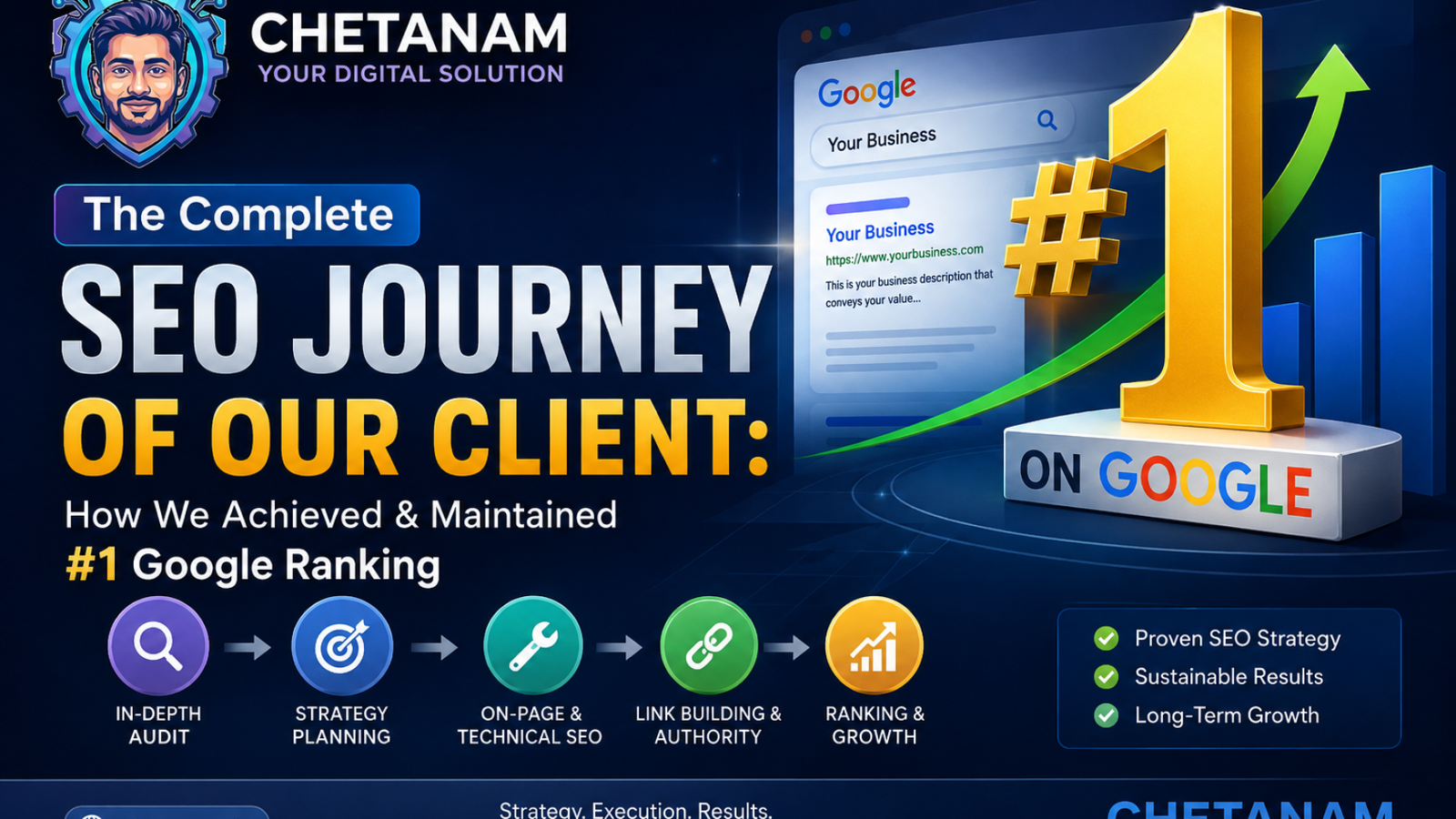
Ranking #1 on Google is rarely the result of one clever trick. It’s the outcome of a structured process — one that starts with understanding a business and their functions in a website to improve SEO rankings sustainably. At Chetanam, every SEO engagement follows this same disciplined path: audit, research, execution, and continuous refinement. This is the complete SEO journey we take a client website through — from the first technical audit to holding a #1 position month after month on several queries.
Step 1: Understanding the Business Before Touching the Website
Before any keyword research or optimization begins, we study what the business actually sells, who it serves, and which pages already earn organic traffic. This baseline — existing rankings, indexed pages, and current Search Console data — tells us where real opportunity lies. Skipping this step is the most common SEO mistake we see: optimizing pages without knowing which ones matter to revenue. Every audit, keyword list, and content decision that follows is built on this business context, not a generic checklist.
Step 2: The Complete SEO Audit
Every journey starts with a full technical SEO audit — checking crawlability, indexability, robots.txt, XML sitemaps, canonical tags, redirects, broken links, duplicate URLs, Core Web Vitals, mobile usability, and structured data. The goal is simple: Google needs to discover, crawl, and understand the site correctly before any content or keyword work can pay off. At Chetanam We prioritize fixes by impact — issues blocking indexing or hurting important pages get fixed first, cosmetic ones later. A technically clean site gives every later stage a stronger foundation to build on.
Step 3: Keyword Research Built Around Search Intent
Keyword research here isn’t about chasing search volume. We perform SEO content mapping by search intent — categorizing every keyword into informational, commercial investigation, transactional, navigational, and local — because someone searching “wooden bed” wants very different information than someone searching “buy wooden bed online.” Once intent is clear, we map keywords to the right page type: homepages target broad business intent, service pages target commercial intent, category pages target product intent, and blog content targets informational searches. This keyword mapping prevents pages from competing for the same query and gives the site a logical structure from day one.
Step 4: Competitor and SERP Gap Analysis
We study the pages already ranking well for target keywords — their content depth, structure, internal linking, and backlink profiles — not to copy them, but to find what’s missing. Where is the competition weak? What questions do they leave unanswered? This competitor SEO analysis becomes the foundation of a practical content gap analysis, showing exactly where our client’s website can offer more complete, more useful answers than what’s currently ranking.
Step 5: Fixing the Technical Foundation
With the audit complete, we resolve indexing errors, canonical issues, duplicate URLs, slow-loading pages, broken internal links, and poor URL structures — prioritized by business impact, not just audit-tool scores. Technical SEO isn’t about chasing a perfect score; it’s about making the website easier for both search engines and real users to navigate.
Step 6: On-Page SEO Without Keyword Stuffing
On-page optimization covers titles, meta descriptions, headings, URLs, internal links, and image alt text — but never at the cost of readability. Repeating a phrase in every paragraph doesn’t help rankings anymore; it hurts them. Instead, we deliver the best SEO services in India by focusing on natural keyword placement, related terminology, and clear answers to three questions every page should address: what is this page about, who is it for, and what should the visitor do next. Search-intent alignment and contextual relevance matter far more today than keyword frequency.
Step 7: Query Fan-Out Content Strategy
This is where most SEO content falls short. When clients ask how to do query fan-out content strategy effectively, we explain that instead of writing one page around one keyword, we build content around the full set of questions a user has before, during, and after their search — what, why, how, cost, comparisons, alternatives, and buying concerns. Around a single product or service keyword, this query fan-out might cover pricing, suitability, maintenance, and what to check before buying. Structuring content this way — clear headings, short paragraphs, direct answers — covers the complete user journey instead of repeating a keyword five different ways. It’s also what makes content easier for AI-driven search to understand, since generative engine optimization (GEO) depends on structured answers, not “writing for a search engine.”
Step 8: E-commerce SEO — Collection and Product Pages
E-commerce sites need a different approach for every page type. Collection and category pages target broader commercial searches, so we optimize the category title, intro content, filters, internal links, and schema to help shoppers understand what’s available. Product pages need transactional-intent content: specifications, materials, benefits, and FAQs that answer what a buyer needs to know before purchasing — not just longer descriptions. Product schema, unique metadata, and review markup round out the technical layer, as part of Chetanam’s dedicated e-commerce SEO work for online stores.
Step 9: Internal Linking and Authority
We connect related pages contextually — blog to category, category to product, service guide to conversion page — so both users and search engines can discover important content easily. Alongside this, ethical off-page work and relevant backlinks build the website’s broader credibility, supporting rankings rather than gaming them.
Step 10: Monitoring, Results, and the First Three Months
SEO decisions should be data-driven. We track keyword positions, organic clicks, impressions, CTR, and — most importantly — leads and conversions, not just rankings. Clients frequently ask how long does SEO take to show results, and while there’s no universal timeline, for many campaigns visible movement in rankings and traffic begins within the first few months, while stronger competitive positions take longer to build. We treat the first three months as the Chetanam growth strategy foundation stage: implement the strategy, measure what moves, and identify the next opportunity — never a guaranteed deadline.
Reaching #1 Is Not the End
A #1 ranking feels like a finish line, but competitors keep improving their pages, and Google keeps updating its systems. Maintaining that position means continuously monitoring ranking fluctuations, refreshing content, watching for new SERP competitors, and adjusting SEO strategy based on SERP updates. The real goal was never just “reach #1” — it’s building a website capable of competing for, and holding, strong organic visibility over time.
Frequently Asked Questions
How long does SEO take to show results?
As part of Chetanam’s growth strategy, while there’s no fixed timeline, many campaigns show early ranking and traffic movement within the first few months, with stronger competitive positions building over time.
How do you avoid keyword stuffing?
By using keywords naturally, supported by related terms, context, and genuinely useful information written for the reader first — not repeated phrases.
How do you optimize content for AI and LLM search?
Through clear structure, direct answers, and consistent, well-organized information — the same qualities that also help traditional search rankings.
How do you maintain a #1 Google ranking?
Through continuous monitoring of rankings, competitors, and content quality, with pages updated as the search landscape shifts.
The Chetanam Approach
This is the complete SEO journey Chetanam follows for every client — audit, research, execution, and continuous improvement — built around real business goals, not a generic checklist. It’s an approach shaped by managing SEO for 50+ active clients and 4,000+ keyword rankings, and it’s why the work doesn’t stop at #1 — it continues from there.